
Hosting a Live Event for Your Small Business? Here’s How an OBM Can Help
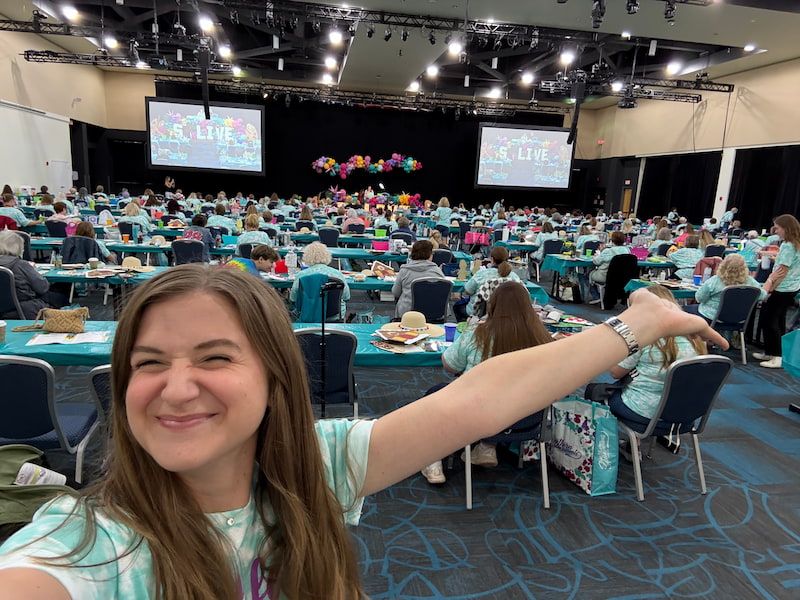
Hosting a live event for your small business is one of the biggest operational lifts you can take on. Most people see the stage and the swag bags. They don’t see the 18 months of planning behind it.
Because hosting a live event means managing the planning timeline, budget and vendors, team assignments, registration, attendee communication, day-of operations, and post-event follow-up.
But these happen to be things I love doing. As an OBM, I own the operational side so the CEO can focus on teaching and connecting with their people. And if you ask my clients, it’s made all the difference.

How an OBM Can Help Plan a Live Event
First, I want you to understand that having an OBM help you plan a live event does not take away the fun parts for you as the CEO. And it also doesn’t mean you can completely offload the whole thing either.
There’s the creative planning and ideation, but then there’s also the logistics that people often don’t think about. What that means for you, the CEO? You don’t have to do it all, and you’ll have time to actually enjoy the event!
What the OBM Owns vs. What the CEO Owns
The OBM owns the timeline, team tasks, vendors, budget tracking, registration systems, attendee communication, and the run of show.
The CEO owns the vision, the content and teaching, final decisions, and being present with attendees.
Your expertise is the experience you’re curating. Mine is handling everything else. If you’ve ever wondered what an OBM does for creative entrepreneurs, a live event is one of the clearest examples.
My Timeline for Planning Live Events With Clients
Before the Event: My Prep Process
For a recurring event, I start by reviewing what we did last time, what we learned, and what we wanted to change. I take copious notes at client events for exactly this reason.
Let’s be honest: we can’t remember what happened a year ago, or, quite frankly, last weekend.
For any event, new or recurring, I map out the framework in a strategy session with the CEO:
- How many days should it be?
- What’s the budget?
- Will we have speakers or guest presenters?
- Are we selling anything at the event?
Once we’ve agreed on the big picture, I build the master plan around it.
Building the Master Plan
If you’ve followed me for a while, the master doc won’t be new to you. It holds every detail the CEO and I discussed in a format the team can use. The CEO signs off first, then it goes to the team.
Budget and Vendors
Venue, catering, supplies, AV, and swag make up most event budgets. I track every quote, contract, and invoice against the budget we set, and I keep every vendor agreement in writing.
Team Assignments
Answering “who owns what?” isn’t just about who handles what once you arrive. It happens in three stages:
- A year or more out, in your project management system, whether that’s Asana or ClickUp.
- The month before, when we’re finalizing the last details.
- The day of, with assignments for every part of the event. Who’s on registration? The vendor booth? Directing A/V?
Clear ownership is what lets your team walk in confident instead of confused.
Registration and Attendee Communication
Attendees should never wonder what happens next. I work with your team to set up and manage the ticketing platform, confirmation emails, pre-event info (schedule, location, what to bring), and waivers or forms from the moment they purchase their tickets and beyond.
During the Event: What I’m Doing Behind the Scenes
If your integrator is doing their job, 95% of the event should run itself. Your team should show up knowing exactly what to do and when. That other 5% matters a lot, because it’s usually the stuff with the biggest effect on the event.
Chaos-Proofing in Real Time
I recently had a client experience a major power surge in the venue’s building during the biggest pitch of her live event, while she was on stage selling her offer. It was unavoidable, for us and for the venue. It knocked out our Wi-Fi and projector screens, and the lights even flickered!
Instead of the CEO stepping off stage to figure out what was happening, I stood beside the stage coordinating, problem-solving on the fly, and telling her what she needed to do in that moment. She kept serving the people in the room. I handled the problem.
That’s chaos-proofing. Unavoidable things will happen. The question is: who’s handling them? (hint: it shouldn’t be you).
Managing Vendors
I meet with your vendors, so you’re not the one checking the final invoice against the quote. If a vendor adds a charge, I’m the one saying, “We already negotiated that. Here’s the email saying it would be comped.” And I’m not afraid to do it either.
Once, a venue was going to charge my client $500 to raise her stage 10 inches. I knew that wasn’t in our planning information, flagged it, and saved her $500 in about 10 minutes.
Fielding Team Questions
I answer your team’s questions so they don’t come to you.
- Who’s this table for?
- Where’s the swag bags?
- Where’s the coffee?
- Are we buying our own lunch?
- I can’t find this attendee on the list, what do I do?
H4: Being the Point of Contact
I become the main point of contact and the emergency contact on every piece of documentation. If something goes wrong, people contact me, because I have the information to solve it. I only loop you in when it’s truly something you need to know.
That frees you to take pictures with your people, present on stage, and even get 10 quiet minutes in the private team space before you go on (yes, I’ve put that on agendas before).
The Biggest Lessons I’ve Learned From Running Live Events
Lesson #1: Some Things Are Unavoidable
Some things can’t be planned for (see my power surge story). You need support to handle them in the moment.
Lesson #2: Always Build a Contingency Into Your Budget
There will always be a final invoice for something that wasn’t accounted for, or something added last minute because it was critical to the attendee experience.
Lesson #3: You’ll Need More Help Than You Think
My recent client’s event, with over 200 attendees in person and 150 virtually, had a roughly 30-page Google Doc as our run of show, covering 18 months of planning. That’s before the spreadsheets, invoices, and contracts. Get more help than you think you need.
Lesson #4: It’s Exhausting, and Deeply Fulfilling
Hosting a live event is more mentally, emotionally, and physically draining than most people expect. But when you run an online business, you get to hear your people’s stories in person and give someone a hug that tells them you created a safe space.
Live events fill my cup more than anything else I do for my clients. Do I lie on the couch for 24 hours afterward? Yes. Do I love it? Also yes.
Hosting a Live Event: FAQ
How far in advance should you start planning a live event for your small business?
Start at least 18 months out for events of 200 or more people, and a minimum of 12 months for any live event. If nothing else, you need time to sell tickets!
What does an OBM do at a live event?
An OBM becomes the main point of contact for all vendors and team members. They negotiate last-minute costs, troubleshoot problems on the fly, handle customer service questions, serve as the emergency contact instead of the CEO, make sure the setup matches the plan, and keep the event on budget.
What’s the most overlooked part of hosting a live event?
The post-event close-out: a team debrief at the end of the event, an attendee survey, and notes on what went well, what didn’t, and what to improve for next time.
Ready to Actually Enjoy Your Next Event?
Planning a live event, retreat, or workshop and want to actually enjoy it? I’ll handle the timeline, the team, the vendors, and the logistics nobody thinks about, so you can be fully present with your people. Learn more about working with me here!